


Data in chart form on a page next to an orange binder
By Lee Hullender Rubin, DAoM, MS, LAc, FABORM
The short answer
It’s unclear whether acupuncture when added only to the day of embryo transfer will improve your chances of having a baby. And, that is likely because the research hasn’t kept up with clinical practice, and two acupuncture sessions are likely not enough treatment. Still, two research reviews published in 2026 asked whether acupuncture alongside IVF leads to more babies born. One, which pooled 18 studies, found somewhat higher live birth rates, mostly in studies that used electrical stimulation, four or more sessions, or treatment before embryo transfer. The other, published in a Lancet journal, first screened out studies with trustworthiness concerns and found no clear effect on live birth. I talked about this study in another post. Both teams rated their evidence as low or very low certainty, so the outcomes are likely to change with more studies.
Key takeaways
A new review of 18 trials (Ganchuluun and colleagues, 2026) found about 8 more live births for every 100 people who had acupuncture, compared with control groups.
A stricter Lancet review (Lensen and colleagues, 2026) kept only trials it judged trustworthy and found no clear difference in live births.
Both reviews agree on one point: traditional needle acupuncture did not lead to more live births than sham (placebo) acupuncture. This is likely because sham (placebo) needling is not inert.
Most of the positive signal in the new review comes from trials the Lancet team did not include in its live birth analysis.
Acupuncture may be supportive during IVF for some people and can be safely added alongside your fertility care.
Why this question keeps coming up
If you're going through IVF, you've probably been asked, or asked yourself, whether you should add acupuncture. It's one of the most common "add-ons," the extra treatments people use alongside standard IVF in hopes of improving their chances. You deserve a straight answer about what the research shows, even when that answer is "it's complicated."
Two large reviews came out this year, a few months apart, and they point in different directions. Here's what each one did, what it found, and why they don't agree.
What the new study did
In September 2026, researchers at China Medical University in Taiwan (Tsend-ayush Ganchuluun, Wei-Ti Hsu, and Shih-Ya Hung) published a review in the European Journal of Integrative Medicine. It's currently an accepted, peer-reviewed "pre-proof," which means the final version may still have small changes.
A review like this doesn't run a new study. Instead, it gathers existing studies and combines their results, which is called a meta-analysis. Here's how this one worked:
Which studies: Randomized controlled trials, where people are assigned by chance to get acupuncture or not. The team searched four large medical databases through July 2026 and included only English-language trials that reported live births.
How many: 18 trials with 4,872 people. Thirteen were done in mainland China or Hong Kong, and the rest in Turkey, Brazil, Denmark, Australia, and the United Kingdom.
What kind of acupuncture: Traditional needle acupuncture (9 trials), electroacupuncture, where a gentle electrical current runs through the needles (4 trials), and TEAS, short for transcutaneous electrical acupoint stimulation, which uses sticky pads on the skin instead of needles (5 trials).
Compared with what: Some trials compared acupuncture with sham or placebo acupuncture. Others compared it with IVF alone.
Main outcome: Live birth, meaning a baby born. This matters because it's the outcome you actually care about. Many earlier studies stopped at pregnancy tests or early ultrasounds.
The team registered their plan before starting (on a registry called PROSPERO), which helps keep researchers from changing their questions after seeing results. They also used a mapping technique to see which acupuncture points tend to be used together, then compared trials that used certain points with trials that didn't.
What it found
Overall: People who had acupuncture had about 8 more live births for every 100 people, compared with control groups. Clinical pregnancy (a pregnancy confirmed on ultrasound) showed a similar pattern, about 9 more per 100.
Electrical stimulation: Trials using TEAS or electroacupuncture showed higher live birth rates. Trials using needles alone did not show a clear difference.
Timing: Acupuncture before embryo transfer was linked with higher live birth rates. Acupuncture only after transfer was not.
Number of sessions: Four or more sessions was linked with higher live birth rates, while fewer than four was not. This was the only one of these patterns that held up when the authors directly tested whether the groups truly differed.
Acupuncture points: Trials that included at least one of five points on the lower abdomen and inner ankle (known as CV3, CV4, CV6, Zigong, and KD3) showed better results than trials that used none of them.
Side effects: Few trials reported them. When they did, they were mild, such as brief discomfort, bruising, headache, or nausea.
What the authors say to be careful about
The authors were candid about the limits of their work, and these limits matter as much as the findings:
Low certainty. Using a standard grading system called GRADE, they rated the overall evidence as low certainty. That means the true impact on outcomes could be quite different from what they found as more research is done.
Possible publication bias. Their tests suggested that small studies with positive results may be overrepresented. Studies that found nothing are less likely to get published, and that can make a treatment look better than it is.
Results varied a lot. The trials disagreed with each other more than chance alone would explain.
No benefit over sham for needle acupuncture. When traditional needle acupuncture was compared with sham acupuncture, there was no difference in live births. The benefit for needle acupuncture appeared only when it was compared with IVF alone.
The acupuncture point findings are early ideas. The authors call these points "candidates for future evaluation." They tested many points without adjusting for the chance of false positives, and a point's apparent effect may really reflect other parts of the same treatment plan.
English-language studies only. Relevant trials in other languages were left out.
The authors describe a sample protocol (electrical stimulation at those five points, four or more sessions before transfer) as something to test in future trials. They are clear that it hasn't been validated as a treatment plan, and it shouldn't be read as one.
A second review reached a different answer
In June 2026, a team led by Sarah Lensen at the University of Melbourne published a review of ten common IVF add-ons in The Lancet Obstetrics, Gynaecology, & Women's Health. The add-ons included genetic testing of embryos, endometrial scratching, steroids, and acupuncture. Several of the authors are editors with Cochrane, a group known for strict standards in reviewing medical evidence.
This review took an extra step. Before combining any results, the team screened every trial for trustworthiness using a checklist called TRACT. A big part of that check was whether the trial was registered publicly before it started, which researchers now treat as a basic sign of a reliable study. They excluded trials that failed the screen, or whose authors couldn't answer questions about how the study was run.
For acupuncture, here's what that looked like:
They found 91 possibly eligible acupuncture trials and excluded 69 for trustworthiness or other concerns, keeping 22.
This included 13 small trials from one hospital group in China. None were registered, and the authors didn't respond when asked how the trials were randomized or whether some reports described the same study.
Ten of the remaining trials, with 3,735 people, reported live births.
Result: No clear difference in live births between acupuncture and control groups. The pattern held whether acupuncture was compared with sham acupuncture or with IVF alone.
They rated the evidence as very low certainty and also found signs of publication bias.
Across all ten add-ons, the Lancet team found no clear evidence of benefit for most of them. Acupuncture was one of five where the evidence was too limited or too low in quality to say either way.
Why two careful reviews can disagree
It can be confusing when experts look at the same question and land in different places. In this case, the main reason is simple: they mostly looked at different studies
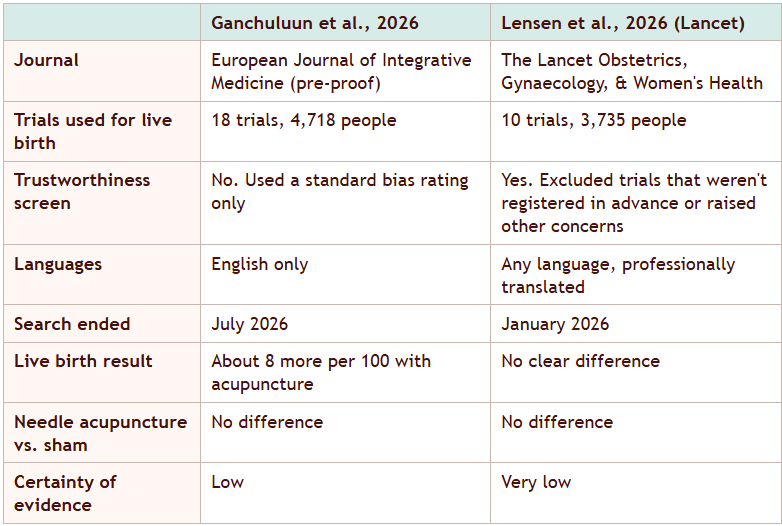
Fig 1 Compares and contrasts the two studies
Only 7 of the 18 trials in the new review appear in the Lancet review's live birth analysis. All 9 of the new review's electrical stimulation trials are among the 11 that don't. The published papers don't say why each one is missing. Some may have been published after the Lancet search ended, and others may not have been registered in advance.
That matters, because the most encouraging results in the new review, for TEAS and electroacupuncture, come almost entirely from trials that the stricter review either excluded or didn't include.
Where the two reviews do look at the same kind of studies, they agree. Traditional needle acupuncture compared with sham acupuncture has not led to more live births. That includes the largest trial of its kind, an Australian and New Zealand study of 848 women published in JAMA in 2018.
There is one more wrinkle. When acupuncture is studied for chronic pain conditions, we have found that sham/placebo needles may not be inert, since it still involves touch, attention, and time to rest. More importantly, some mechanistic studies have found it induces physiological responses like increases in circulating opioids with sham needling and changes in how opioids bind in the brain. We aren’t clear on how this influences fertility. But, if this holds true, sham comparisons could hide a real treatment effect. It's an open question, and neither of these reviews can settle it.
What this means for you
Here's my honest opinion. The research can't yet tell us whether acupuncture around embryo transfer increases your chance of having a baby through IVF. The new review raises some interesting questions about electrical stimulation, timing, and number of sessions, and those questions deserve well-designed, registered trials. There are more observational studies that are finding associations of benefits, but RCTs are the gold standard to assess effects.
That doesn't mean acupuncture has nothing to offer. Many people come to us for support with the stress, sleep problems, and emotional weight of IVF, and some people find that sessions give them a calmer space during a demanding process. Acupuncture may be supportive in that way, and it's often used alongside fertility treatment. What it isn't is a replacement for the care your fertility team provides.
If you're thinking about acupuncture during IVF, here are a few questions worth asking any acupuncturist, including us:
What does the research show, and how certain is it?
How many sessions do you recommend, when, and what will it cost in total?
How will you coordinate with my fertility clinic and the timing of my cycle?
Do you offer electroacupuncture or TEAS, and why or why not for me?
And please let your fertility team know you're having acupuncture, so everyone caring for you has the full picture.
Questions people often ask
Does acupuncture improve IVF success rates?
The evidence is mixed and low in certainty. A 2026 review of 18 trials found about 8 more live births per 100 people with acupuncture, while a stricter 2026 Lancet review that excluded untrustworthy trials found no clear difference. Neither result is certain enough to say acupuncture improves your chances. However, observational studies suggest positive associations with improving outcomes, but more research is needed to clarify the true effects of acupuncture, when it should be done,
What is TEAS?
TEAS stands for transcutaneous electrical acupoint stimulation. It sends a mild electrical current through sticky pads placed on acupuncture points, with no needles. Most TEAS trials for IVF have been done in China. We use it regularly in our clinical practice to help people do treatments at home and reduce cost burden.
How many acupuncture sessions are used in IVF studies?
It varies widely, from one or two sessions on the day of embryo transfer to treatment over several weeks. In the 2026 Ganchuluun review, trials with four or more sessions showed better live birth results than trials with fewer, but this hasn't been confirmed in a trial designed to test it directly.
Should acupuncture be done before or after embryo transfer?
In the Ganchuluun review, acupuncture before transfer was linked with higher live birth rates, and acupuncture only after transfer was not. The authors note that the difference between the two wasn't statistically confirmed, so it's an idea to test, not a settled answer.
Is acupuncture safe during IVF?
Overall, acupuncture is quite safe when provided by trained and licensed acupuncturists. In the trials that reported side effects, they were generally mild, such as brief discomfort, bruising, headache, or nausea. Many trials didn't report side effects at all, so it's worth choosing a licensed acupuncturist with experience in fertility care and keeping your fertility team informed.
Sources
Ganchuluun T, Hsu WT, Hung SY. Efficacy of acupuncture and optimal acupoint selection for in vitro fertilization outcomes: systematic review, meta-analysis, and data mining study. European Journal of Integrative Medicine. 2026 (journal pre-proof). https://doi.org/10.1016/j.eujim.2026.102765
Lensen S, Wilkinson J, Steeper M, et al. Safety and effectiveness of ten common in-vitro fertilisation add-ons: a systematic review and meta-analysis. The Lancet Obstetrics, Gynaecology, & Women's Health. 2026;2:e624-36. https://doi.org/10.1016/S3050-5038(26)00054-300054-3)
Smith CA, de Lacey S, Chapman M, et al. Effect of acupuncture vs sham acupuncture on live births among women undergoing in vitro fertilization: a randomized clinical trial. JAMA. 2018;319(19):1990-1998. https://doi.org/10.1001/jama.2018.5336
Craig LB, Rubin LEH, Peck JD, Anderson M, Marshall LA, Soules MR. Acupuncture performed before and after embryo transfer: a randomized controlled trial. Journal of Reproductive Medicine. 2014;59:313-20.