

Can You Exercise During Fertility Treatment? What Three New Studies Actually Found
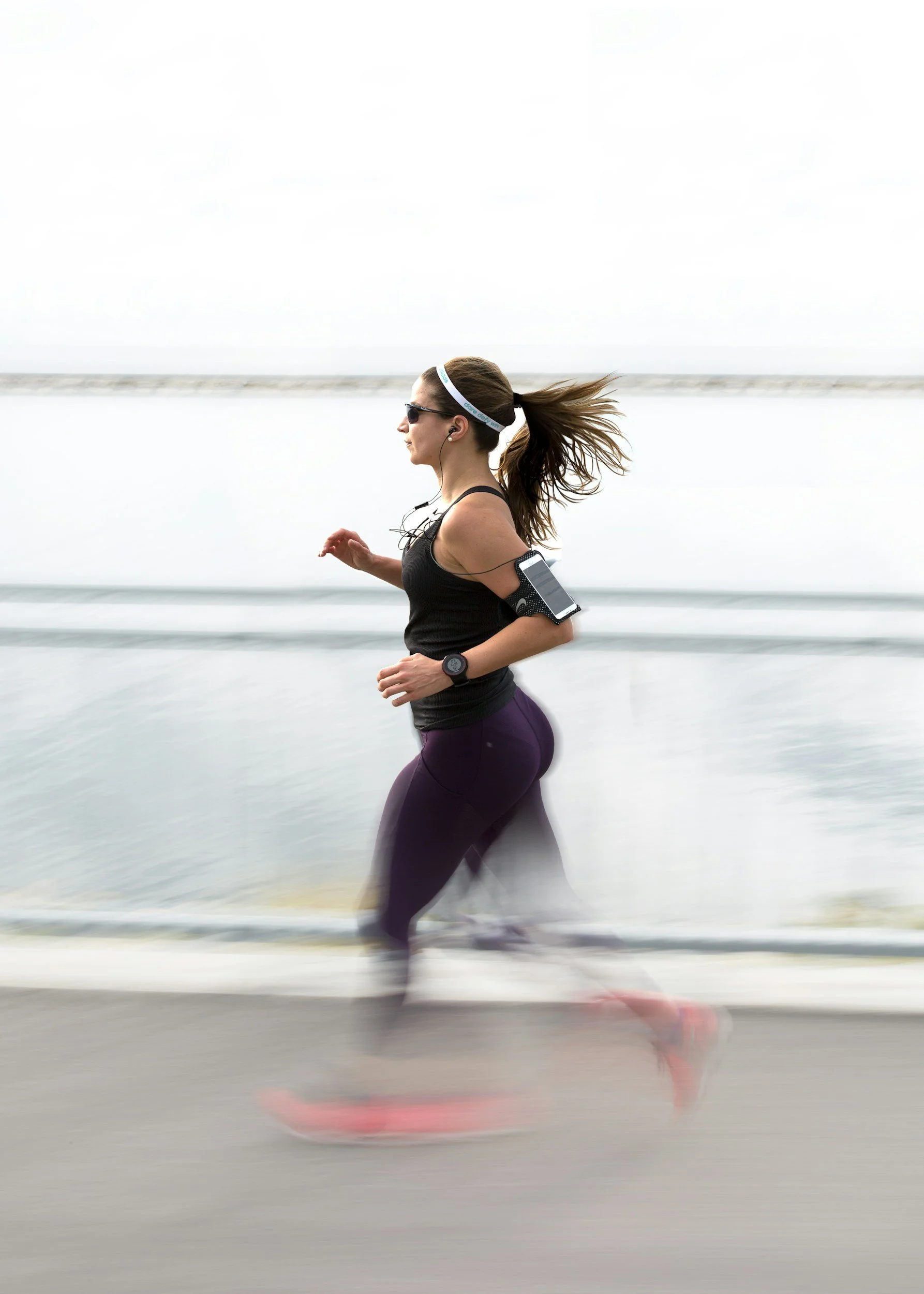
A person is running in a blurred image and is wearing purple spandex leggings and a black tank top wears dark sunglasses, a white hairband, and has their hair tied in a ponytail. They are also wearing a device on their upper arm with wired headphones.
By Lee Hullender Rubin, DAoM, MS, LAc
Should You Exercise During IVF? Recent Research Found It Won't Hurt Your Chances
You just had your embryo transfer. You walk out of the clinic, climb into the car, and immediately wonder: Should I be lying down right now? Can I go for a walk tomorrow? What about my yoga class?
If you have ever asked AI "can I exercise after embryo transfer," you already know the internet offers a dizzying mix of advice. Some forums (and REIs) say total bed rest. Others say keep moving. Your clinic might tell you to "take it easy" without defining what that actually means.
Three recent studies tackled this exact question, and the answers may surprise you. The bottom line? Moving your body during fertility treatment does not appear to hurt your chances of getting pregnant, and restricting activity might do more harm than good.
Let me walk you through the evidence.
The FitBit Study That Tracked Every Step of a Frozen Embryo Transfer Cycle
The first study, called the SSTEP trial, published in Fertility and Sterility in 2026, asked a straightforward question: does your physical activity level during a frozen embryo transfer (FET) cycle affect whether you get pregnant?
Researchers at the University of Iowa gave 82 women FitBits and asked them to wear them around the clock for their entire FET cycles. The trackers recorded daily steps, active minutes, calories burned, heart rate, and sleep patterns. The research team also measured salivary cortisol levels (a stress hormone) and had participants complete a validated questionnaire about infertility-related stress.
The participants averaged about 7,000 steps per day, which is a solid amount of daily movement. Researchers then compared women who became pregnant (51 women) to those who did not (31 women) and looked at every metric the FitBit collected.
The result? No differences. Daily step counts did not differ between the two groups before transfer, after transfer, or across the full cycle. Activity intensity, calories burned, heart rate, and sleep patterns were all the same.
Here is where it gets interesting. The women who became pregnant actually increased their step count slightly after the embryo transfer, while those who did not become pregnant decreased theirs. That difference was statistically significant. The study was not designed to prove that reducing activity causes worse outcomes, but it raises a provocative question: could the common instinct to "just lie still" after a transfer actually be counterproductive?
The stress findings were equally reassuring. Cortisol levels measured two days before transfer showed no difference between the pregnant and non-pregnant groups. Perceived stress scores were also similar. In other words, the worry and anxiety (and maybe the stress about being stressed?) many patients carry into a transfer cycle did not appear to sabotage the outcome.
What About Exercise Before Fertility Treatment Starts?
The second study took a longer view. Published in Fertility and Sterility Reports in 2023, this was a secondary analysis of the FIT-PLESE trial, a large, NIH-funded, multicenter study of larger-bodied women diagnosed with unexplained infertility. All 379 participants went through a 16-week lifestyle modification program that included increased physical activity (tracked with FitBit devices), followed by up to three cycles of clomiphene and intrauterine insemination (IUI).
Researchers divided participants into the most active third (averaging over 10,000 steps per day) and the least active third (averaging about 6,400 steps per day). The more active group lost more weight, had lower blood sugar markers, lower triglycerides, and reported fewer symptoms of depression.
But here is the key finding: live birth rates were virtually identical. About 19% of the active group and 20% of the less active group delivered a baby. Clinical pregnancy rates, miscarriage rates, and even "good birth outcomes" (defined as a healthy, full-term baby) showed no differences between the groups.
This tells us two important things. Even substantial increases in physical activity, well beyond what most people do in a day, did not harm fertility in women with obesity undergoing treatment. It also didn’t increase IUI outcomes compared with less active women. The more active women gained clear metabolic and mental health benefits without any reproductive cost.
The Bigger Picture: A Review of Exercise and Fertility Across Populations
The third paper, a mini-review also published in Fertility and Sterility Reports in 2023, pulled together the available research on exercise and fertility across three different groups of women: healthy women trying to conceive naturally, women with PCOS, and women undergoing assisted reproduction like IVF.
The review revealed that the effect of exercise on fertility depends heavily on who you are and what kind of treatment you are pursuing.
For women undergoing IVF or FET, the evidence consistently shows that regular physical activity has either no effect or a small positive effect on treatment outcomes. The biological explanation is intuitive: the main way vigorous exercise can harm fertility in a natural cycle is by disrupting ovulation, causing luteal phase defects or skipped cycles. But during IVF and FET, medications control the entire hormonal process. Ovulation is either triggered precisely or bypassed entirely. So the primary risk pathway simply does not apply.
For women with PCOS, exercise appears actively beneficial, and vigorous activity may work better than moderate activity. Studies show that structured aerobic exercise can improve ovulation rates through insulin-sensitizing effects that operate independently of weight loss. That is an important distinction: even if the scale does not budge, exercise can still improve reproductive function in this population.
For healthy-weight women trying to conceive naturally, the picture is more nuanced. Large prospective studies show that vigorous exercise (five or more hours per week) can reduce the odds of conceiving, but moderate exercise actually improves them. The critical factor appears to be energy balance, not movement itself. A 2015 randomized controlled trial found that when women increased their caloric intake to match what they burned during vigorous workouts, menstrual cycle disruptions largely disappeared. The exercise was not the problem. The calorie deficit was.
What This Means for You
If you are in the middle of an IVF or FET cycle, these studies collectively send a clear message: you do not need to stop moving. Walking, light exercise, and maintaining your normal routine appear to be perfectly safe. The decades-old instinct to prescribe bed rest after embryo transfer has no support in the research, and the SSTEP trial adds wearable-tech data to a growing body of evidence against it.
If you are preparing for treatment and have PCOS, there is good reason to embrace a exercise routine. The benefits go beyond weight loss and appear to directly improve ovulatory function.
If you are a healthy-weight person trying to conceive naturally and you exercise intensely, the one thing worth paying attention to is fueling your body adequately. Make sure you eat enough to support your training. If your cycles become irregular or your luteal phase seems short, consider dialing back intensity or increasing calories rather than abandoning exercise altogether.
And perhaps most reassuringly, the stress you feel during this process, while very real and worth addressing for your own wellbeing, does not appear to be the thing standing between you and a positive pregnancy test.
The Bottom Line
The old advice to "just relax and stay still" after an embryo transfer is not supported by the evidence. Three recent studies, using objective tracking tools and rigorous methods, point in the same direction: moderate physical activity during fertility treatment is safe and may even support better outcomes. Your body was made to move. Trust it.
References:
Jacobs E, Summers K, Van Voorhis B. The impact of physical activity and stress on frozen embryo transfer cycles: the step and stress tracking to estimate pregnancy (SSTEP) trial. Fertil Steril. 2026;125:401-410. https://doi.org/10.1016/j.fertnstert.2025.08.039
Vitek WS, Sun F, Cardozo E, et al. Moderate and increased physical activity is not detrimental to live birth rates among women with unexplained infertility and obesity. Fertil Steril Rep. 2023;4:308-312. https://doi.org/10.1016/j.xfre.2023.06.004
Mussawar M, Balsom AA, Totosy de Zepetnek JO, Gordon JL. The effect of physical activity on fertility: a mini-review. Fertil Steril Rep. 2023;4:150-158. https://doi.org/10.1016/j.xfre.2023.04.005